
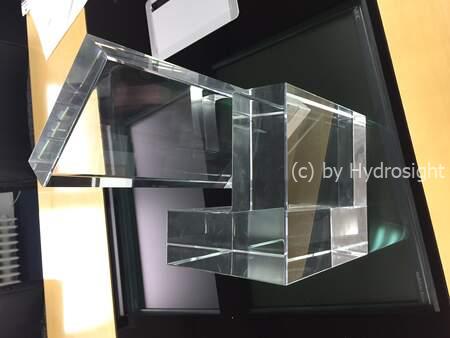
Glas über Eck / Eckverklebung
Bonding acrylic (polymethyl methacrylate, or PMMA) is a crucial technique in various industries where strong, durable, and optically clear joints are required. Hydrosight offers bonded acrylic solutions when the desired product's shape or size requires it.
Optical Quality
Once cured, the adhesive becomes virtually invisible and optically clear, perfectly matching the transparency of the PMMA itself. This creates a seamless joint that doesn't obstruct vision, making it ideal for applications such as aquariums or pool windows.
The chemical compatibility of the cement enables it to fuse closely with the acrylic surface, minimizing distortions and ensuring light passes through unimpeded, just as it would through a single, monolithic piece of PMMA.
Mechanical Strength
The chemical similarity between the PMMA and the solvent cement allows the adhesive to bond deeply with the acrylic surface. When the cement hardens, it effectively forms a single polymer structure, resulting in a bond that is comparable in strength to the virgin acrylic material. Fusion bonds avoid the disadvantages of mechanical fastening, which include the introduction of stress risers or the need for elastic seals.
Process Complexities
Bonding large or complex acrylic pieces requires careful management of a multitude of factors, as the process is highly sensitive:
- Cement Type: Choosing the correct solvent or polymerization cement.
- Heat Management: Controlling the heat liberated by the chemical reaction of the cement.
- Dimensional Stability: Accounting for the shrinkage of the cement as it cures.
- Environmental Control: Maintaining ambient temperature and preventing the inclusion of air bubbles during bonding.
Most importantly, to ensure structural integrity, stress relieving processes must be performed before/after bonding. The locked-in strains that are introduced during the process need to be relieved by a controlled annealing procedure. This requires large tempering ovens that can contain the bonded product. Heating times for normalizing acrylic castings are typically long (e.g., nearly 100 hours for a 100 mm block), and the rising and lowering of the temperature also requires careful control.
Overall, Hydrosight acrylic bonds deliver a very rewarding result, impressing with optical quality, longevity, and strength.
On site bonding
Chemical bonding on site should always be considered the second choice. This is because the entire window needs to be tempered in a tempering oven after bonding. Some companies that offer on-site bonding do not temper at all. Some companies offer local tempering. While this can be a solution where no other possibility exists, it does not relieve the acrylic blocks of all their internal stress. Accelerated ageing and crazing will be the result. Where possible, bonding should be performed in the factory.