
Underwater Windows for Ships and Yachts
Hydrosight makes acrylic windows for ships that carry water pressure: hull windows below or close to the waterline, windows in glass-bottom boats, curved windows for semi-submarines and glazing for pools on board. The acrylic is bonded into a steel frame and tested at the factory; the shipyard welds the frame into the hull, or our own installation team installs it.
- Pool glazing for eight cruise ships
- More than 100 windows on excursion vessels in Egypt
- Pressure-rated acrylic, PVHO-grade on request
- DNV certificate on request
Pools on Cruise Ships and Superyachts
The task: pools on superyachts, ocean cruise ships and river cruise ships increasingly have glass walls, so guests can see into the water from the deck or from below. On a ship, the glazing has to handle more than the water pressure: the water sloshes with every movement of the ship, the hull flexes and twists in the sea, and in the tropics an empty pool in direct sun gets very hot.
How we build it: acrylic has less than half the density of glass, which saves weight high up on the ship. It expands about four times as much as stainless steel, so in large pool modules it rests on a polyurethane elastomer bed that takes up this movement and the twisting of the hull without point loads. The designs cover a temperature range of −15 °C to +45 °C; the joints are sealed with a structural silicone with ETAG 002 approval, in a light color that heats up less in the sun. Many solutions from pools on land also work on board: open-top glass walls, glass corners and glass bottoms.
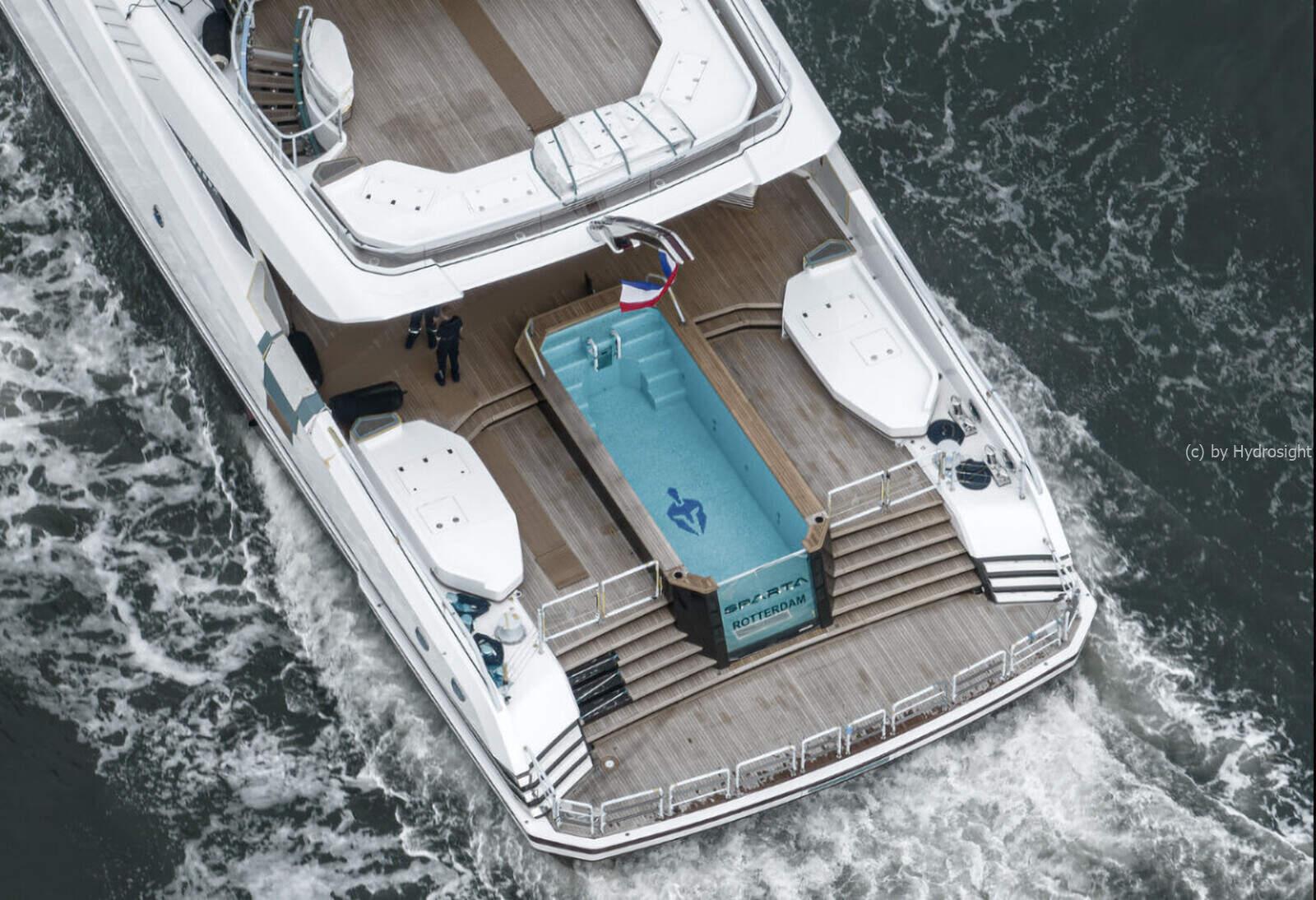
Projects: Hydrosight has equipped eight cruise ships with pool glazing so far. In 2023, we built, delivered and installed the glass wall of the stern pool on the superyacht Sparta. Two projects are currently in progress for a well-known cruise ship builder:
- Ocean cruise ship: a deep-water and a shallow-water pool on the top deck with freestanding acrylic walls, supported on three sides. The acrylic panels are more than 10 m long, a complete module weighs up to 9 t, and the design covers wind gusts of up to 70 m/s.
- River cruise ships: a curved acrylic panel of 6.2 × 1.5 m that is the pool wall and the outer balustrade at the same time, from the pool up to the ceiling of the superstructure, without a top rail. Built for a series of sister ships.
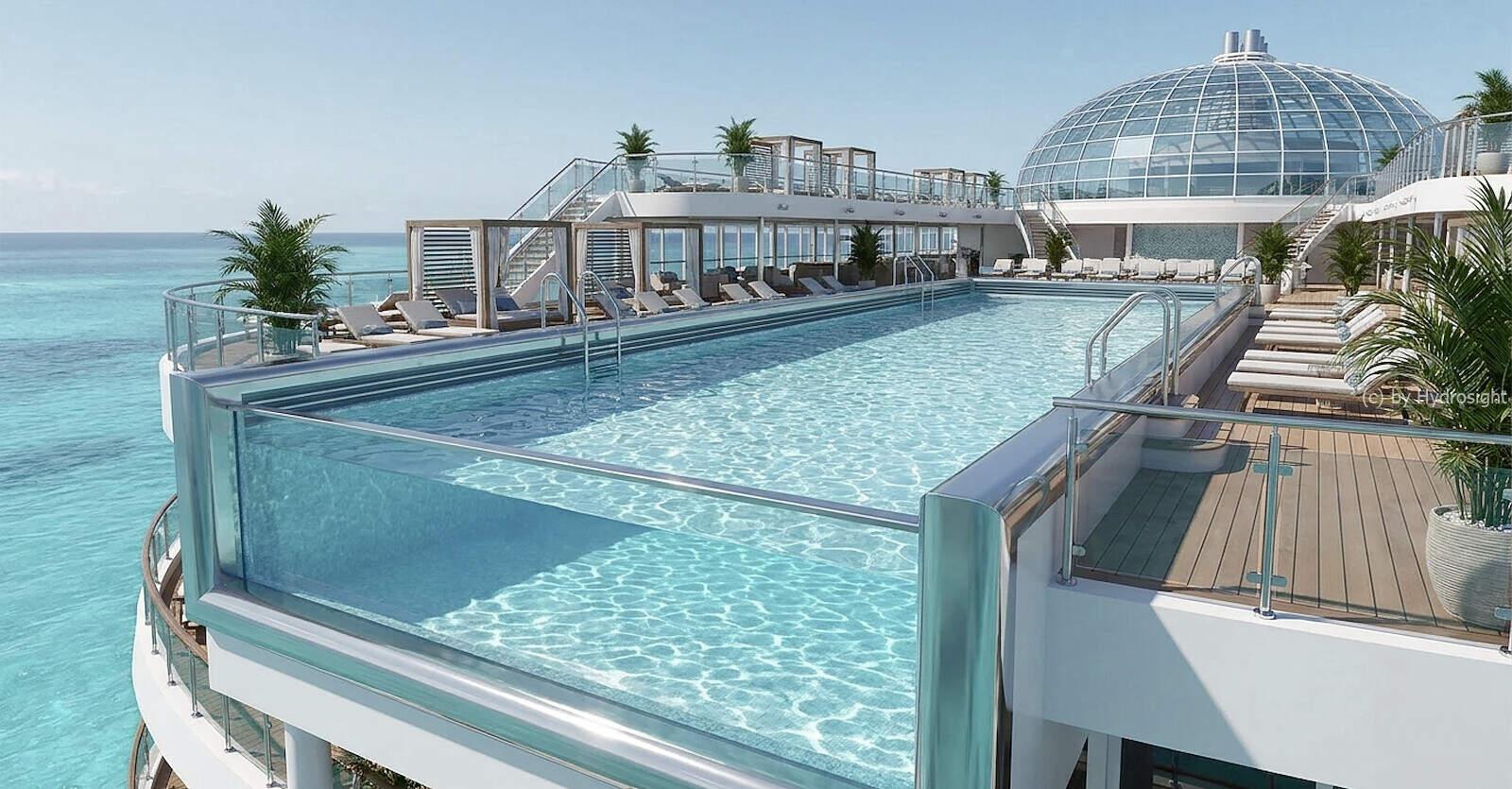
Visualization: pool with an acrylic glass wall on the top deck of a cruise ship.
Acrylic Hull Windows on Yachts
The task: windows in the hull bring daylight and a view of the sea into guest cabins and other rooms on the lower deck. The lowest row is the most demanding: under the rules of classification societies such as ABS and DNV, windows up to about 0.5 m above the waterline count as underwater windows. Even if they are above the water in calm conditions, they have to withstand wave impact ("slamming").
How we build it: for these positions, acrylic is the material of choice, because under overload it deforms plastically instead of breaking suddenly; classification societies often require PVHO-grade acrylic. More in the comparison of glass and acrylic. We supply complete windows in a steel frame, ready to be welded into the hull.
Project: the 32 m superyacht Dream On was built by Dunya Yachts at the Ursa shipyard near Istanbul, Turkey. Hydrosight designed, produced and delivered the acrylic windows of the lowest hull row, the row closest to the waterline; the windows were installed by the shipyard.
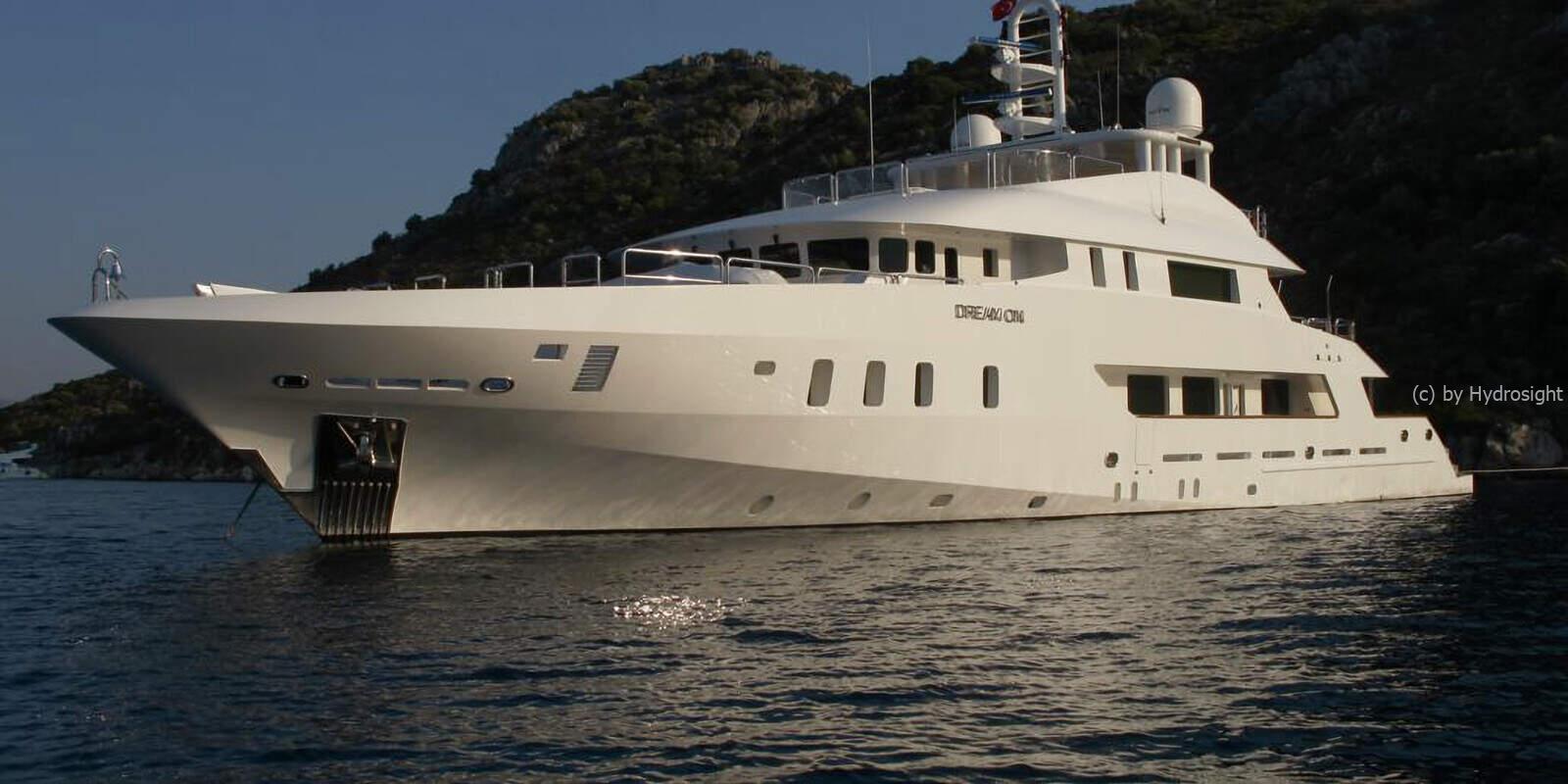
The 32 m superyacht Dream On by Dunya Yachts, Istanbul: Hydrosight supplied the acrylic windows of the lowest hull row.
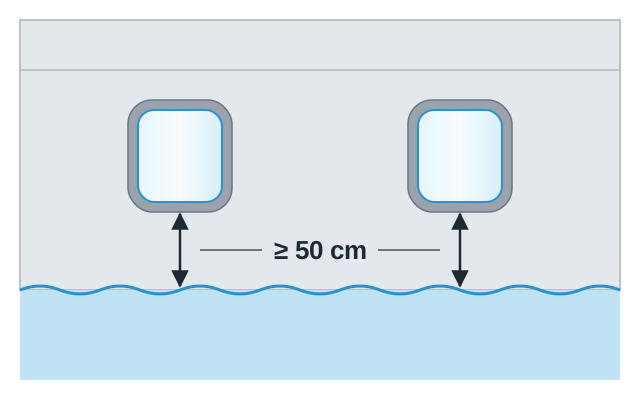
Under ABS rules, hull windows need a distance of at least 0.5 m to the waterline; windows closer to the water count as underwater windows (schematic).
Glass-Bottom Boats and Excursion Vessels
The task: on a glass-bottom boat or an excursion vessel with windows below the waterline, the view of the underwater world is the reason passengers come on board. The windows sit in the bottom or in the sides of the hull and are in the water all the time, so they have to stay watertight and clear for many years.
How we build it: the acrylic is glazed into a steel frame and leak-tested at our factory; the shipyard welds the frame into the hull (see factory-tested modules).
Projects: between 2011 and 2012, Hydrosight delivered and partly installed the underwater windows for two cruise and excursion catamarans built by Tornado Marine in Suez, Egypt. The sides of each hull carry a row of underwater windows; more than 100 Hydrosight windows are installed in the two boats. Smaller boats can be fitted too: a former fishing boat was converted into an excursion vessel with windows that lie partly below the waterline, so passengers see the sea and the underwater world at the same time.
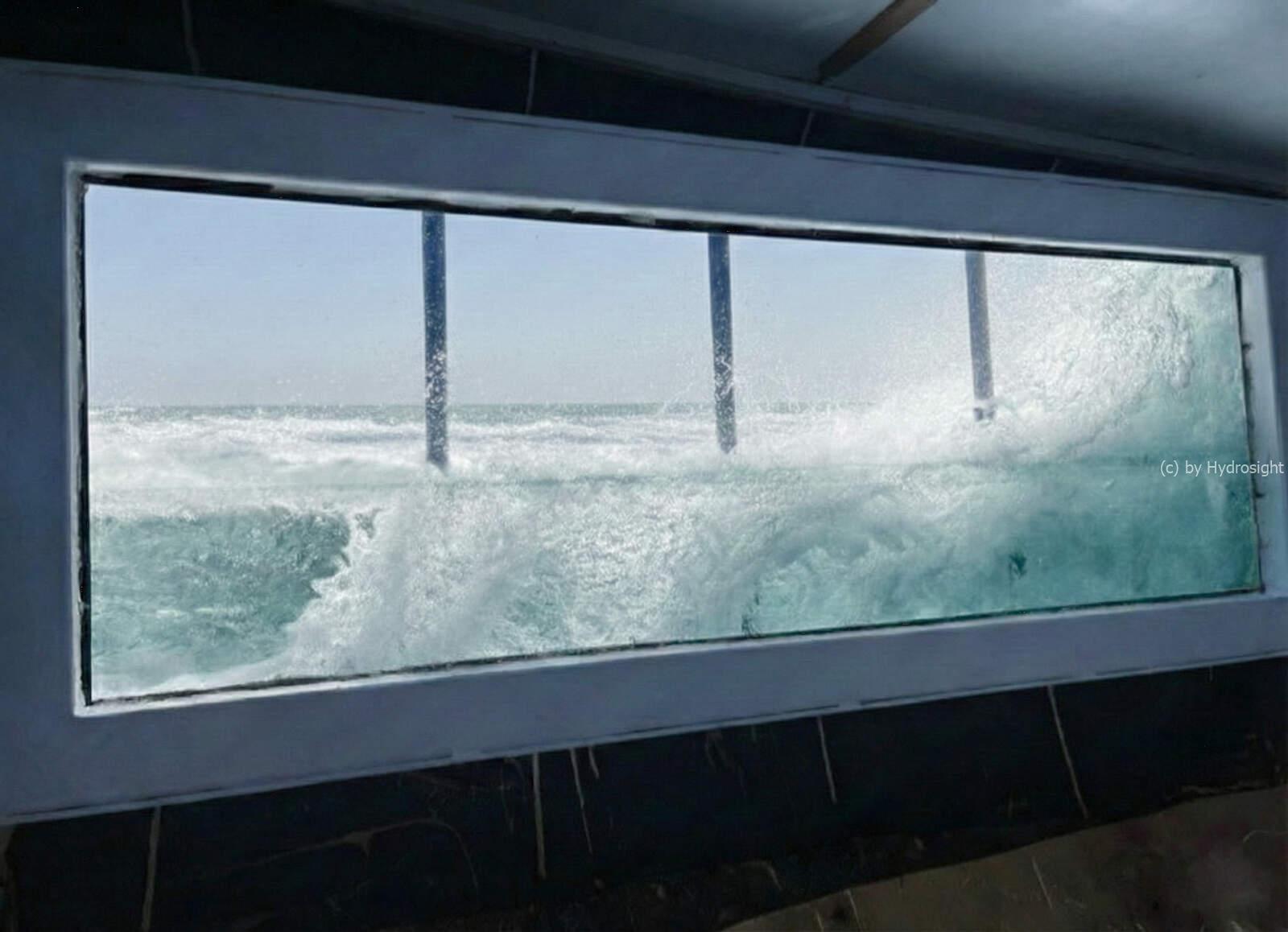
View through an underwater window of a converted fishing boat on the IJsselmeer, Netherlands: the window lies partly below the waterline, and passengers see the sea and the water below the surface.
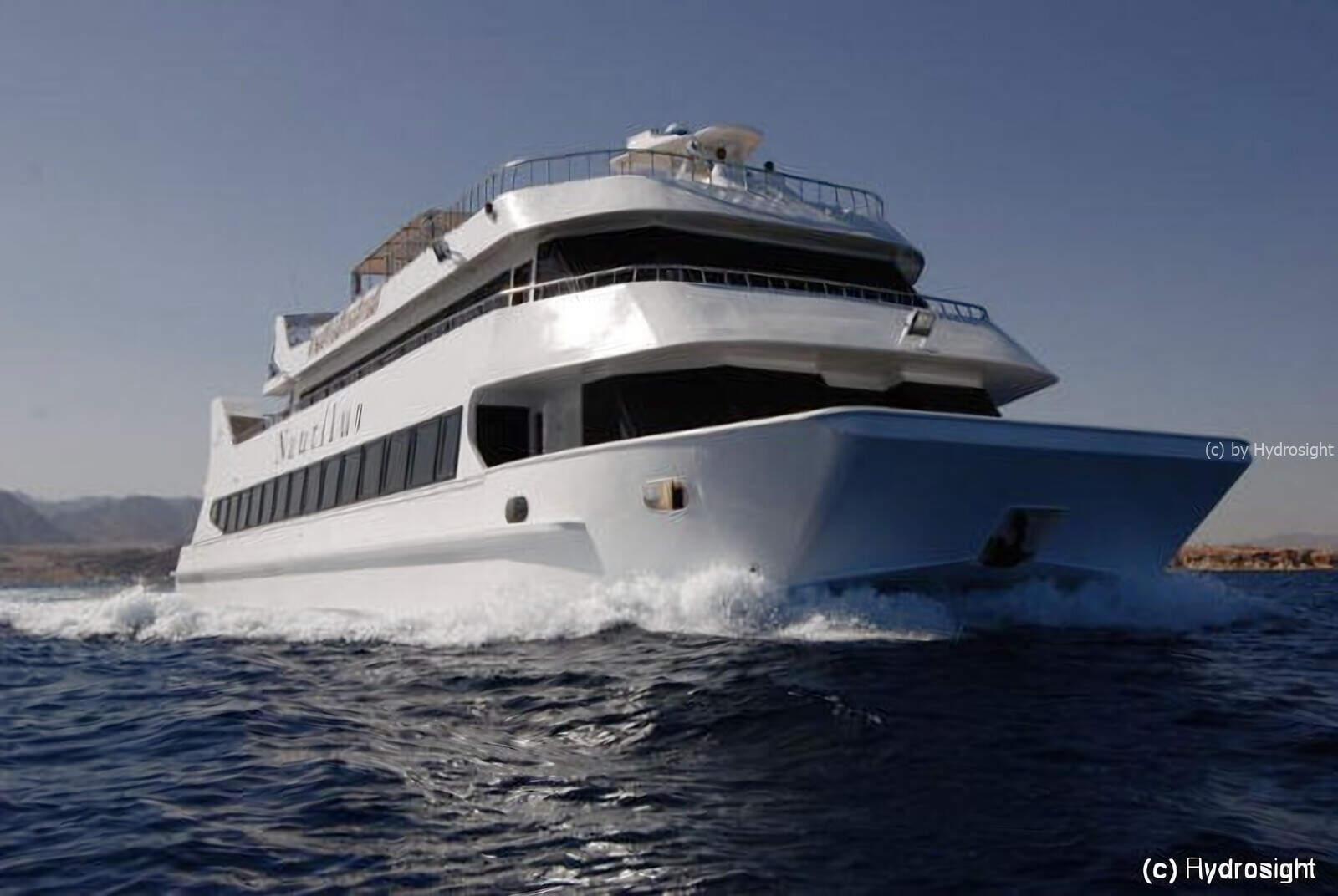
Excursion catamaran by Tornado Marine with Hydrosight underwater windows in the hulls, Egypt.
Semi-Submarines
The task: a semi-submarine looks like a submarine but never fully submerges. The passenger cabin lies below the waterline, and large windows in the hull give a clear view of the underwater world. The windows are permanently under water pressure and often follow the curved shape of the hull, which reduces water resistance.
How we build it: acrylic is particularly suitable for windows that are part of a water-retaining structure, where laminated glass quickly reaches its limits. We supply curved acrylic panels that follow the lines of the hull, made of PVHO-grade acrylic if the classification society requires it.
Project: Big Marlin is a tourist semi-submarine that takes visitors out around the island of Krk in Croatia; it was built at a shipyard in Zadar. Its hull was designed without right angles, and the windows follow it with a slight radius. Hydrosight supplied the curved windows, 2.5 × 1 m each, made of PVHO-grade acrylic; the hull and the installation were done by the shipyard.
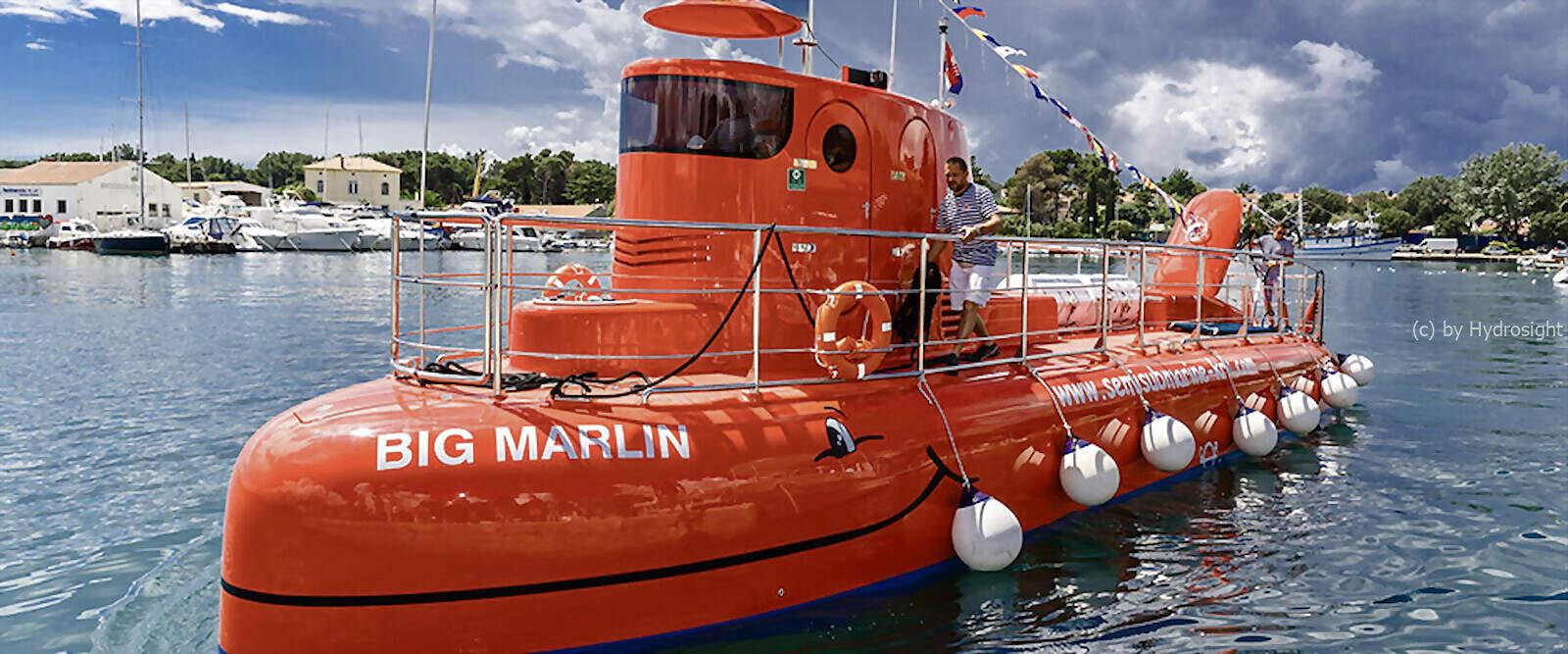
The tourist semi-submarine Big Marlin in Croatia, with curved acrylic windows by Hydrosight below the waterline.
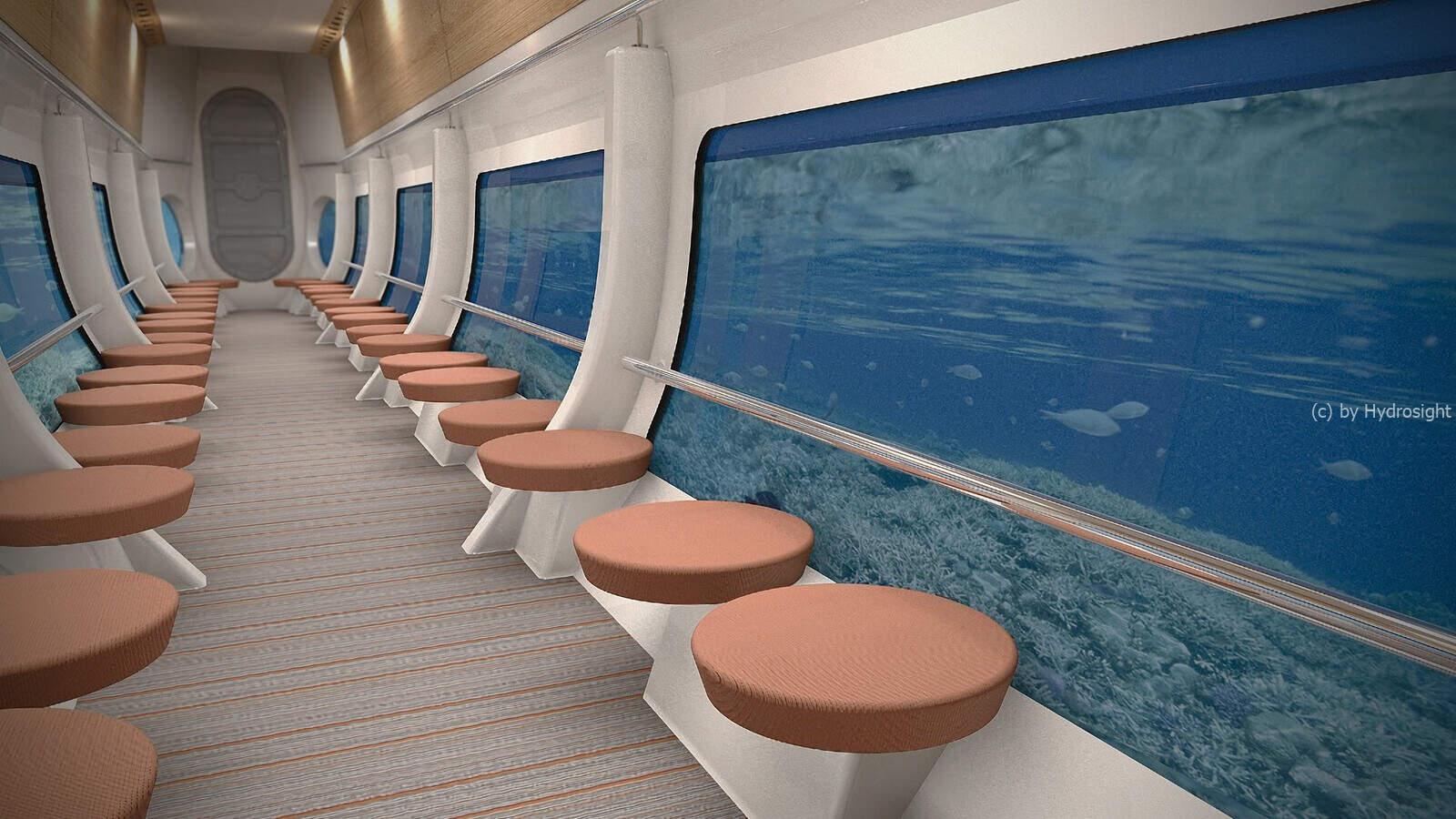
Rendering of the passenger cabin with the curved acrylic windows.
Factory-Tested Window Modules
Underwater windows are often glazed and sealed at the shipyard, directly in the hull. The seal can then only be tested in a sea trial, and this often has to be repeated until every window is watertight. Hydrosight delivers complete modules instead: the acrylic is bonded and sealed into the steel frame in our workshop, and every module is pressure- and leak-tested before delivery. The shipyard welds the module into the hull as a whole, or our own installation team installs it.
| Glazing at the shipyard | Hydrosight module from the factory | |
|---|---|---|
| Conditions | Dust, grinding sparks, changing weather and humidity | Controlled temperature and humidity in our workshop |
| Bond and seal | Risk of contaminated surfaces and poor adhesion | Bonded with matching primers under controlled conditions |
| Testing | Difficult on site, often only in a sea trial | Pressure and leak test of every module before delivery |
| Installation | Weather-dependent, labor-intensive fitting | Module is welded in as a whole |
| Risk | Rework, delays and warranty claims | Less time at the shipyard, no glazing work on board |
Engineering, Frame and Certification
Every marine window is made to order for its position in the hull. Based on the shipyard's general arrangement and loads, we calculate the window and supply the drawings for the shipyard and for approval by the classification society.
- Calculation: the acrylic thickness is calculated for each window from its size, the water pressure and the wave loads at its position. For pools on board, a finite element analysis (FEA) combines water pressure, sloshing, wind and hull deflection.
- Design limits: acrylic creeps slowly under permanent load. The long-term stress on the water side is therefore limited to 3 MPa, on the dry side to 5 MPa; short peak loads such as wave impact and sloshing are checked with a safety factor of 4 on the guaranteed minimum strength of the acrylic.
- Frame: stainless steel 1.4571 / AISI 316Ti or steel, welded into the hull.
- Certification: certificates are issued for each project by the classification society, for example DNV; our designs follow the rules that apply to the vessel, such as DNV-RU-UWT and DNV-RU-SHIP. Our materials and our production meet the requirements of ASME PVHO-1; material certificates to EN 10204 3.1 on request.
- Service life: the windows are built to last 30 years or more (see the operation and maintenance manual).
- Lead time: 3 to 4 months after drawing approval.
To discuss a project, send us the hull drawing or the general arrangement with the planned window positions through the contact form.
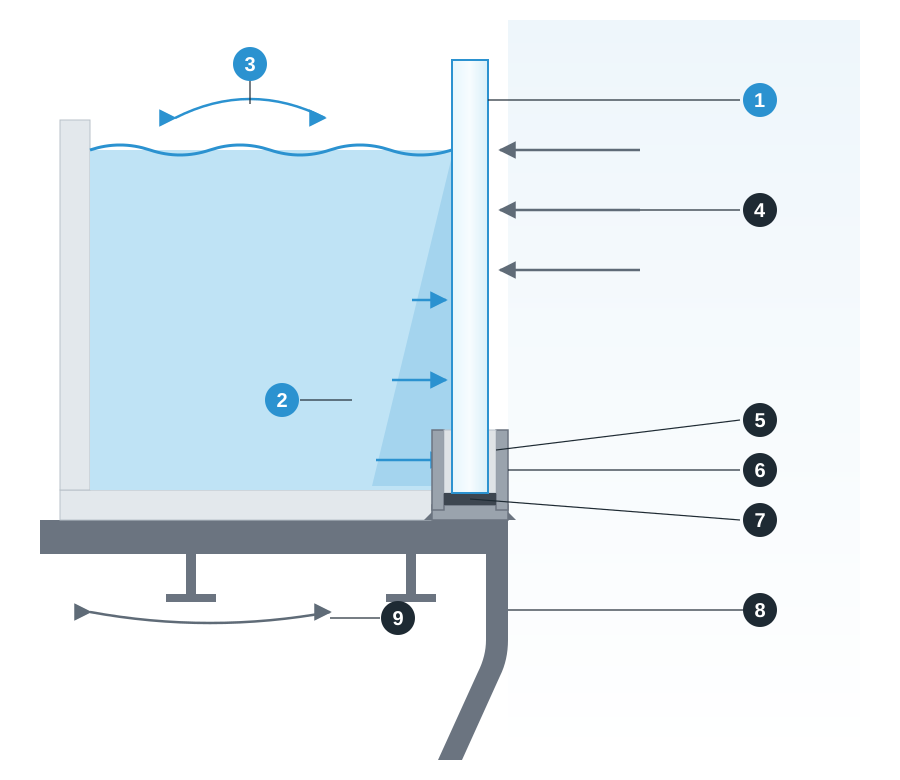
Pool wall on a cruise ship that is also the balustrade, schematic section:
- Acrylic panel
- Water pressure
- Sloshing
- Wind load
- Structural silicone joint
- Stainless steel frame
- Elastomer bed
- Ship deck and side shell of the hull
- Deflection of the hull
Who We Work For
Our customers in the marine sector are shipyards and yacht builders, operators of excursion vessels and navies.




Frequently Asked Questions
Your question is not answered here? Send it to us and we will be glad to answer it.
Ask Your QuestionDo you also supply cabin windows, hatches or windscreens?
No. We only make windows that carry water pressure: hull windows below or close to the waterline, windows in glass-bottom boats and semi-submarines, and glazing for pools on board. For cabin windows, hatches and windscreens above the waterline, please contact a marine glazier.
Which classification societies do you work with?
On request, we supply windows with a DNV certificate (formerly Germanischer Lloyd, GL). Windows close to the waterline are designed according to the rules of the classification society of the vessel, for example ABS or DNV; please tell us which rules apply to your project.
Why acrylic and not glass below the waterline?
Acrylic deforms under overload instead of breaking suddenly, so it absorbs wave impact without brittle fracture; this is why it has been used for decades for submarine viewports and the windows of semi-submarines. It weighs less than half as much as glass and can be cast thick and formed into curved panels. Its drawback is the surface: it scratches more easily, so windows in the superstructure, on the bridge or in the salon are usually made of glass. See the comparison of glass and acrylic.
What does a classification society require for a pool on board?
The glazing of a pool on a ship is a safety-relevant structural element. Depending on the vessel, the rules of the classification society apply, for example DNV-RU-UWT for underwater windows. We provide the calculation (FEA), drawings and material certificates for approval; the certificate itself is issued for each project by the classification society.
Can acrylic withstand tropical heat on deck?
Yes, if the design takes it into account. Acrylic expands about four times as much as stainless steel and softens at high temperatures, so we design for a temperature range of −15 °C to +45 °C, use flexible bedding and light-colored joints, and limit the long-term stress in the acrylic.
How thick is the acrylic of a ship's underwater window?
There is no standard thickness. It is calculated for each window from its size, the water pressure and the wave loads at its position in the hull.
Can an existing ship be fitted with underwater windows?
Often, yes, for example when an excursion vessel or a fishing boat is converted. The opening and the frame have to be integrated into the hull structure by a shipyard. Send us the hull drawing and the planned window positions, and we will check what is possible.
How long does it take to make a ship's underwater window?
Manufacturing takes 3 to 4 months after you approve the drawings, depending on the workload in our production; in urgent cases it can be faster. Please contact us early in the design of the vessel.
What does an underwater window for a ship cost?
Marine windows are made individually for each vessel, so there is no list price. The price depends on the size and number of windows, the shape, the water pressure, the frame and the required certificates. Send us your drawings through the contact form, and you will receive a quote.
How do I care for acrylic windows on board?
Clean them with a soft, damp microfiber cloth and mild cleaning agents; never use alcohol-based glass cleaners or solvents. Scratches in acrylic can be polished out. Details are in the operation and maintenance manual.